
When I started at Adobe, I was working long days and long weeks at my desk. I was focused, I was busy, and I wasn't paying much attention to how I was sitting.
My body was paying attention though. The first place I felt it was my lower and mid back. A tight, tired feeling that built up through the day. Then it moved up into my upper shoulders and my neck.
I still feel it sometimes after a long session at the desk. The difference is that now I know what it means. It's my cue to move.
THE THREE FIXES MOST PEOPLE TRY
When people notice their posture getting worse, they usually try one of these:
Pulling the shoulders back. It feels good for a minute. Then you get busy, forget about it, and slump back into the same position.
Buying an ergonomic chair. A good chair can help. But having a good chair doesn't mean you sit well in it. A lot of people have an expensive chair and still sit exactly the way they did before.
Stretching once in a while. A stretch now and then feels nice, but once a week, or once in a blue moon, is not enough to undo eight to ten hours of sitting every day.
WHY THEY DON'T WORK ON THEIR OWN
Each of these deals with one small piece of the problem. The real problem is what sitting does to your muscles.
When you sit for long hours, some muscles barely get used. Mainly your glutes, your core and your lower back. Over time the body forgets how to use them properly. Other muscles do the opposite. Your neck and shoulders work overtime holding your head forward toward the screen.
So even if you sit well in a great chair, the muscles that should be supporting you are still switched off. That's why the problem keeps coming back.
WHAT I DO INSTEAD
From my training in Integrated Movement Science with the CHEK Institute, and from my own years at the desk, I've learned that good posture needs a combination of things, not one quick fix. This is what works for me.
First, I strengthen what sitting switches off. My strength program focuses a lot on my glutes, my lower back and my core. Those are the muscles that let me sit for long hours without feeling it in my back the way I used to.
Second, I stretch what's overused. My neck and shoulders, and I work on my thoracic curve, which is the rounding of the upper back that comes from leaning toward the screen.
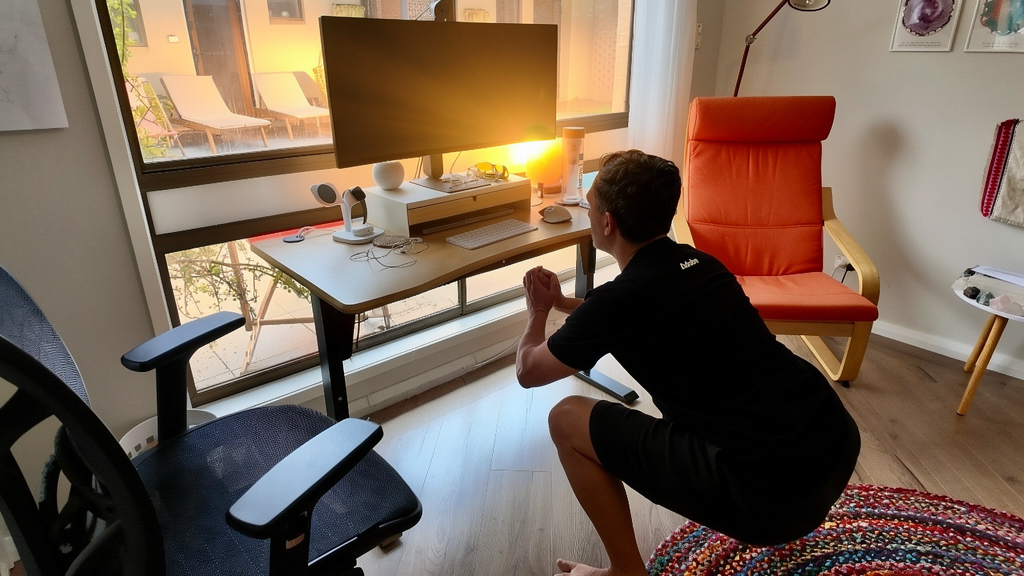
Third, I take movement snacks. Every 30 minutes to an hour, I get up and move. Nothing fancy. A few squats, some lunges, push-ups against the desk or the wall (they don't need to be proper push-ups), and sometimes a few jumping jacks.
THE SMALL BOTTLE TRICK
Here's my favourite little trick. I switched to a smaller water bottle. Because it runs out faster, I have to get up and refill it more often. And once I'm up, I usually do a few of those movement snacks before I sit down again.
It's simple, and that's why it works. I move more, and I drink more water too.
START WITH ONE THING
You don't need to change everything this week. Pick one thing. Maybe it's the smaller bottle. Maybe it's five squats every time you stand up. Small changes, done often, will do more for your back than a fancy chair.
One note: if your back pain is sharp, constant or getting worse, get it checked by a health professional first.
If your back, neck or shoulders are already telling you something, I'd love to help. In a free 20-minute chat we can look at what's going on and where to start.